
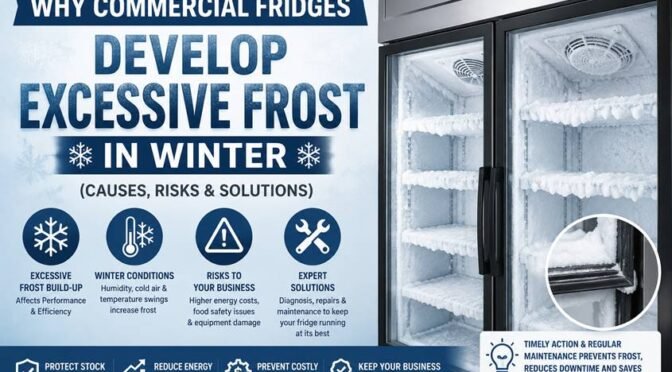
It seems counterintuitive: the weather cools down, yet your commercial fridge starts icing up worse than ever. Every winter, refrigeration technicians see a spike in callouts for commercial fridge frost build up — display fridges coated in ice, freezers with frozen-over evaporator coils, and cool rooms struggling to hold temperature.
The truth is that winter creates a unique set of refrigeration problems. Fluctuating ambient temperatures, indoor heating, higher kitchen humidity, and busy hospitality trade all combine to push more moisture into your equipment than at almost any other time of year. When that moisture meets a cold evaporator coil, frost forms — and if your defrost system, door gaskets, or drainage can’t keep up, that frost quickly becomes a thick layer of ice.
This guide explains why commercial fridges develop excessive frost in winter, the most common causes, the risks of ignoring it, and what you can safely do about it.
How Frost Forms Inside Commercial Refrigeration
To understand commercial fridge ice build up, it helps to understand the refrigeration cycle itself.
Every commercial fridge or freezer works by circulating refrigerant through a closed loop. The compressor pumps refrigerant to the condenser, where heat is rejected to the surrounding air. The refrigerant then travels to the evaporator coil inside the cabinet, where it absorbs heat from the air. An evaporator fan blows air across this cold coil, and that chilled air circulates through the cabinet to keep your stock at the correct temperature.
Here’s the key point: the evaporator coil is always the coldest surface inside the fridge — usually well below 0°C, even in a chiller.
Whenever warm, humid air enters the cabinet — through door openings, a leaking door gasket, or hot food being loaded — the moisture in that air condenses on the cold evaporator coil. Because the coil is below freezing, that condensation instantly turns to frost.
A light layer of frost is completely normal. That’s why commercial refrigeration includes a defrost system — typically a defrost timer or electronic temperature controller, a defrost heater, and a defrost sensor — that periodically melts the frost. The meltwater runs down the drain line into a drain pan, where it evaporates.
Excessive frost occurs when one of two things happens:
- Too much moisture is entering the cabinet (more than the defrost cycle can handle), or
- The defrost system isn’t working properly (so normal frost never gets removed).
In winter, both problems tend to occur at once.
Why Winter Makes Frost Worse
Cold weather outside doesn’t mean dry conditions inside. In fact, winter is often the worst season for commercial fridge frost, for several reasons.
Higher indoor humidity. Heated kitchens, steam from cooking, dishwashers running constantly, and closed doors and windows (to keep warmth in) all trap moisture indoors. Relative humidity inside a busy café or restaurant kitchen in winter can be surprisingly high — and every gram of that moisture is available to condense inside your fridge.
Busy hospitality trade. Winter is peak season for many venues — hot food, coffee, functions, and holiday trade. More customers means more door openings, and every door opening lets a fresh charge of warm, humid air into the cabinet. Staff propping doors open during rush periods makes this dramatically worse.
Greater temperature differences. The bigger the temperature gap between the air entering the cabinet and the evaporator coil, the faster condensation and frost form. A heated kitchen at 24°C against a freezer coil at −25°C creates a huge temperature differential — far larger than in milder months.
Fluctuating ambient temperature. Commercial refrigeration is designed to operate within a specific ambient temperature range. Cold overnight temperatures followed by heated daytime conditions can confuse temperature controllers, alter refrigerant pressures, and cause the system to run irregular cycles — including missed or shortened defrosts.
Moisture ingress from the environment. Wet weather means wet floors, damp deliveries, wet packaging, and moisture tracked in on trolleys and crates. All of it ends up as humidity — and eventually as frost on your evaporator.
The result: your fridge is fighting more moisture in winter, often with a defrost system that was only just coping in summer.
Common Causes of Commercial Fridge Frost Build Up
If your commercial fridge is icing up, one or more of the following causes is almost always responsible.
1. Door Gasket Failure
The door gasket is the flexible seal around the door. When it’s torn, hardened, warped, or has lost its magnetism, warm humid air continuously leaks into the cabinet — 24 hours a day, not just when the door opens.
A simple test: close the door on a piece of paper. If you can slide it out easily, the gasket isn’t sealing. Failed gaskets are one of the single most common causes of excessive frost in commercial fridges, and one of the cheapest to fix. Telltale signs include ice concentrated near the door edges and condensation around the door frame.
2. Blocked Drain Line
During each defrost cycle, meltwater must flow down the drain line into the drain pan. If the drain is blocked with debris, mould, or ice, that water pools in the cabinet and refreezes — often as a sheet of ice on the floor of the fridge or around the evaporator housing.
Yes — a blocked drain can absolutely cause ice build-up, and it compounds itself: each defrost cycle adds more water that can’t escape, so the ice layer grows daily.
3. Defrost System Failure
If your commercial fridge is not defrosting, frost accumulates continuously until the evaporator coil is completely encased in ice. Common failure points include:
- Defrost heater — a burnt-out heater element means frost is never melted.
- Defrost timer — a failed timer never initiates the defrost cycle.
- Defrost sensor / termination thermostat — a faulty sensor can end defrost cycles too early or prevent them from starting.
- Controller programming — incorrect defrost frequency or duration settings, sometimes changed accidentally.
A fully iced-up evaporator coil behind the rear panel is the classic sign of defrost failure.
4. Poor Airflow and Air Circulation
Refrigeration depends on consistent air circulation across the evaporator coil and around the cabinet. When airflow is restricted, cold spots form, humidity lingers, and frost builds unevenly. Blocked vents, stock pushed against the rear air outlets, and dirty coils all restrict airflow.
5. Overloaded Shelves
Can overloading a fridge create frost? Yes. Overloading:
- Blocks air vents and disrupts circulation
- Forces the compressor to run longer to hold temperature
- Increases moisture load if warm or uncovered food is loaded
- Creates warm pockets where condensation forms and migrates to the coil
Display fridges are particularly vulnerable — display fridge icing often traces back to over-stacked shelves blocking the air curtain.
6. Evaporator Fan Problems
If the evaporator fan is failing, running slowly, or iced up itself, air stops moving across the coil. Moisture-laden air stagnates, frost forms rapidly on the coil, and cabinet temperature rises even as ice grows. A fridge that’s icing up and struggling to hold temperature often has a fan fault.
7. Temperature Controller Faults
The temperature controller manages the entire refrigeration cycle — compressor run times, fan operation, and defrost scheduling. A faulty or badly programmed controller can cause the fridge to run too cold (freezing everything), skip defrost cycles, or short-cycle the compressor. If your commercial fridge is freezing everything, a controller or probe fault is a prime suspect.
8. Faulty Temperature Sensors and Probes
Sensors tell the controller what’s happening inside the cabinet. A drifted or failed probe can report the wrong temperature, causing the system to over-run, over-cool, and over-frost. Sensor faults often appear as erratic temperature readings or a cabinet that swings between too warm and frozen solid.
Why Frost Should Never Be Ignored
A frosted-up commercial fridge isn’t just untidy — it’s actively costing you money and putting stock at risk.
Higher electricity bills. Frost acts as an insulating blanket on the evaporator coil. Even a few millimetres of ice significantly reduces heat transfer, forcing the compressor to run longer and harder to achieve the same cooling. Heavily frosted units can consume dramatically more power — so yes, frost directly increases electricity bills.
Reduced cooling performance. Because ice insulates the coil and blocks airflow, a frosted fridge cools less effectively, not more. Cabinet temperatures creep up even while the machine runs constantly.
Compressor wear and premature failure. The compressor is the most expensive component in the system. Extended run times, high head pressures, and possible liquid refrigerant flood-back caused by an iced evaporator all shorten compressor life. Many compressor failures trace back to months of ignored frost.
Temperature fluctuations and food safety. Erratic cabinet temperatures push stored food outside safe holding temperatures. Under HACCP food safety requirements, chilled food generally must be held at or below 5°C — a frost-compromised fridge can silently breach this, exposing your business to food safety violations, failed inspections, and liability.
Stock loss. Freezer burn, frozen produce in chillers, spoiled dairy and meat — frost-related temperature problems destroy stock. A single spoiled cool room of perishables can cost more than years of preventative maintenance.
Component damage. Ice expands. It can bend evaporator fan blades, crack drain pans, split drain lines, damage coil fins, and break door hinges when doors are forced against ice. What starts as a frost problem often ends as a multi-component repair.
Can You Remove the Ice Yourself?
For light frost, a careful manual defrost is reasonable:
- Move stock to another fridge or insulated containers.
- Switch the unit off and prop the doors open.
- Let the ice melt naturally — this can take several hours.
- Place towels and shallow trays to catch meltwater.
- Clean and dry the interior, check the drain is clear, then restart and confirm the unit reaches temperature before restocking.
What not to do:
- Never chip or pry at ice with knives, scrapers, or screwdrivers. Evaporator coils are thin-walled and pressurised — one puncture releases the refrigerant charge and turns a defrost into a major repair, potentially requiring coil replacement and regassing.
- Never use boiling water or heat guns. Sudden thermal shock can crack plastic components, warp panels, and damage the coil. Boiling water also floods the drain system faster than it can cope.
- Don’t just defrost and forget. A manual defrost removes the symptom, not the cause. If the ice returns within days or weeks, something is wrong.
Call a professional refrigeration technician if:
- Ice returns quickly after a full defrost
- The evaporator coil ices up completely
- The unit can’t hold temperature
- You suspect a defrost heater, timer, sensor, fan, or controller fault
- There are unusual noises, tripping breakers, or signs of refrigerant leaks
These are electrical and refrigerant-system faults that require licensed diagnosis and repair.
Preventing Frost During Winter
Most winter refrigeration problems are preventable with good habits and scheduled maintenance:
- Inspect and replace door gaskets before winter. It’s the cheapest, highest-impact frost prevention there is.
- Book a pre-winter preventative maintenance service. A technician will clean condenser and evaporator coils, verify defrost operation, test sensors and the temperature controller, check refrigerant pressures, and clear drain lines and drain pans.
- Train staff on door discipline. Close doors promptly, never prop them open, and check they’ve latched.
- Load stock correctly. Keep vents clear, don’t exceed load lines, cover all food, and never load hot food directly into refrigeration.
- Manage kitchen humidity. Use extraction fans, ventilate where possible, and keep fridges away from steam sources like dishwashers and combi ovens.
- Monitor temperatures daily. Logging cabinet temperatures (already required under most HACCP plans) catches frost-related drift early.
- Watch the ambient environment. Ensure units aren’t positioned where cold overnight air or heating vents cause big ambient temperature swings.
Businesses Most Affected by Winter Frost Problems
Winter frost build-up hits some businesses harder than others:
- Cafés — constant door openings on display fridges during peak morning trade, plus espresso machine steam raising humidity.
- Restaurants — high-humidity kitchens, heavy prep loads, and under-bench fridges opened hundreds of times per service.
- Bottle shops — large glass-door display fridges with big air curtains, highly sensitive to gasket wear and door traffic.
- Supermarkets — open display cases and multideck fridges where store heating and customer traffic drive condensation.
- Cake shops and patisseries — display fridges holding delicate, moisture-sensitive stock where icing ruins presentation and product.
- Florists — floral fridges run at higher humidity by design, making drainage and defrost performance critical.
- Convenience stores — long trading hours, constant door traffic, and often older equipment nearing the end of its defrost components’ life.
If your business fits one of these profiles, a pre-winter refrigeration check is one of the best investments you can make.
Frequently Asked Questions
Why does a commercial fridge build up frost in winter?
Winter increases indoor humidity (heating, cooking steam, closed ventilation) and hospitality door traffic, pushing more moisture into the cabinet. That moisture condenses and freezes on the evaporator coil. Combined with ambient temperature swings that disrupt defrost cycles, frost accumulates faster than the system can remove it.
Does cold weather cause more frost?
Indirectly, yes. Cold outdoor weather leads to heated, humid, poorly ventilated indoor spaces and larger temperature differentials between room air and the evaporator coil — both of which accelerate condensation and frost formation.
Can damaged door seals cause ice?
Yes — failed door gaskets are one of the most common causes. A leaking seal lets warm humid air stream into the cabinet continuously, and that moisture freezes on the coil. Ice concentrated near door edges is a classic sign.
Why is my commercial fridge freezing everything?
Usually a faulty temperature sensor, a failed or badly programmed temperature controller, or a stuck relay keeping the compressor running. Occasionally it’s stock placed directly in the cold air stream. This needs professional diagnosis — over-freezing also accelerates frost build-up.
Can blocked drains cause ice?
Yes. If the drain line is blocked, defrost meltwater can’t escape and refreezes inside the cabinet, typically as a sheet of ice on the fridge floor or around the evaporator. The problem compounds with every defrost cycle.
Can overloading a fridge create frost?
Yes. Overloading blocks air circulation, forces longer compressor run times, and adds moisture load — all of which increase frost. Keep vents clear and stay within load lines.
Does frost reduce cooling?
Significantly. Ice insulates the evaporator coil and blocks airflow, so heat transfer drops and cabinet temperatures rise even though the unit runs harder and longer.
Does frost increase electricity bills?
Yes. An iced coil forces the compressor to run far longer to achieve less cooling. Heavily frosted units can use substantially more energy than a clean, well-maintained equivalent.
Is some frost in a commercial freezer normal?
A light, even dusting of frost between defrost cycles is normal. Thick ice, sheets of ice on the floor, iced-over fans, or a fully encased coil are not — they indicate a fault.
How often should a commercial fridge defrost?
Most units run automatic defrost cycles several times per day, set by the defrost timer or electronic controller. If frost is accumulating, the frequency or duration may need adjusting — or a defrost component has failed.
Can I use a hair dryer or hot water to defrost my commercial fridge?
Avoid it. Thermal shock and concentrated heat can crack plastics, warp panels, and damage the evaporator coil. A natural defrost with the unit switched off and doors open is far safer.
Why does my display fridge ice up around the glass doors?
Glass-door display fridges rely on door heaters and tight gaskets to prevent condensation. Failed door frame heaters, worn gaskets, or high shop humidity all cause icing and fogging around the doors.
Is frost a food safety risk under HACCP?
It can be. Frost-related temperature fluctuations can push chilled food above safe holding temperatures (generally 5°C or below), breaching HACCP requirements. Daily temperature logging helps catch this early.
How do I stop my commercial fridge icing up in winter?
Replace worn gaskets, keep drains clear, enforce door discipline, load stock correctly, manage kitchen humidity, and book a pre-winter preventative maintenance service to test the defrost system, sensors, fans, and controller.
When should I call a refrigeration technician?
If ice returns quickly after a full defrost, the coil ices over completely, the unit can’t hold temperature, or you suspect a heater, timer, sensor, fan, or controller fault. These require licensed diagnosis — and early repairs are always cheaper than compressor replacement or lost stock.
