
Commercial Fridge Regas Sydney
Same-day and 24/7 emergency refrigerant leak repair and recharge for Sydney businesses. Licensed technicians, correct-weight charging, 12-month warranty on parts and labour.
Call 0452 525 914 or book online for immediate service across Greater Sydney.
What Is a Commercial Fridge Regas?
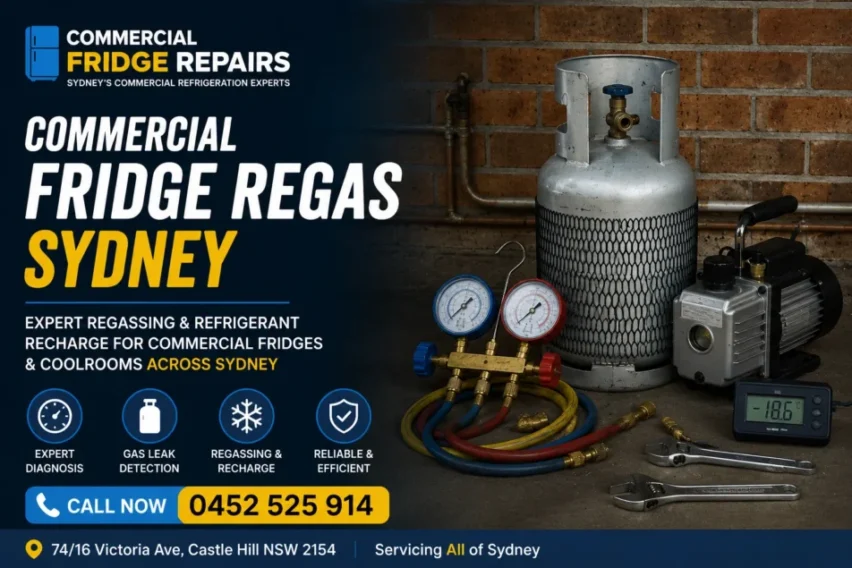
A commercial fridge regas means recovering the remaining refrigerant from a sealed refrigeration system, finding and repairing the leak that caused the loss, evacuating the system under vacuum, and recharging it with the exact refrigerant type and weight specified on the equipment nameplate.
Here is the part most businesses in Sydney are never told: refrigerant is not consumed. A commercial fridge, freezer or coolroom operates on a closed loop. The refrigerant circulates through the compressor, condenser, expansion valve or capillary tube, and evaporator continuously, and it never gets used up the way fuel or oil does.
So if your system is low on gas, it did not "run out". It leaked. And every litre that escaped will escape again unless the leak is repaired.
That is why we do not sell a standalone "top-up" service. A top-up on a leaking system buys you a few weeks, costs you the gas twice, and in Australia releasing fluorocarbon refrigerant to atmosphere is against the law. What we sell is leak detection, sealed system repair, and a correct recharge — done once, properly.
Fridge or Coolroom Down Right Now?
If your stock is warming, do not wait for a diagnosis to book. Call us and start the clock.
Signs Your Commercial Fridge Needs a Regas
Low refrigerant produces a specific pattern of symptoms. These are the ones our technicians see most often across Sydney kitchens, coolrooms and display cabinets.
The cabinet runs warm but the compressor never stops
This is the classic low-charge signature. With less refrigerant circulating, the system cannot move enough heat, so it never reaches cut-out temperature and simply runs continuously. Your power bill climbs while your product sits above safe temperature.
Temperature holds overnight but fails during service
A marginal charge can cope with a closed, stable cabinet and then collapse the moment doors start opening and warm product goes in. If your display fridge is fine at 7am and 8°C by midday, suspect refrigerant loss before you blame the staff.
Partial frosting on the evaporator coil
On a correctly charged system the evaporator frosts evenly across its face. When the charge is low, only the first section of the coil — the inlet end — gets cold enough to frost, and the rest stays bare. Partial or patchy evaporator icing is one of the most reliable visual indicators of undercharge, and it is something you can check yourself before you call.
Short cycling
The compressor starts, runs briefly, cuts out on a low-pressure switch, then restarts. Short cycling is hard on the compressor's start components and motor windings, and a system that is short cycling on low pressure is often only weeks away from a compressor failure.
Hissing or bubbling from the pipework
An audible hiss at the expansion valve, or bubbles visible in the sight glass on systems fitted with one, indicates the refrigerant is arriving at the metering device as a gas-liquid mix rather than solid liquid. That means undercharge or restriction.
Oily residue on joints, brazed connections or the evaporator
Refrigerant carries compressor oil around the circuit with it. Where gas escapes, oil escapes with it and then stays behind as a dark, dusty film. Oil staining at a joint is a leak until proven otherwise. Check brazed joints, service valves, the suction line, and the return bends on the evaporator.
Ice forming on the suction line or compressor
A frosted suction line running back to the compressor suggests liquid refrigerant is not fully boiling off in the evaporator — often a symptom of low charge combined with poor airflow, and a genuine risk of liquid slugging the compressor.
Important: Every one of these symptoms can also be produced by a dirty condenser, a failed evaporator fan, a blocked defrost drain, a faulty controller, or worn door seals. That is why the diagnosis comes first, and the gas comes last.
Why Commercial Refrigeration Loses Gas
Commercial systems leak far more often than domestic ones, and for identifiable reasons.
| Cause | Where it shows up |
|---|---|
| Vibration fatigue | Brazed joints and capillary lines on compressors running long hours in busy kitchens |
| Corrosion of the evaporator | Coolrooms and cabinets exposed to salt, brine, cleaning chemicals or acidic food residues |
| Schrader / service valve seepage | Slow loss over months from valve cores after servicing |
| Physical damage | Coolroom evaporators and condenser coils struck by trolleys, stock, pallets or forklifts |
| Flare and mechanical joints | Split systems and remote condensing units where joints loosen with thermal cycling |
| Poor previous workmanship | Cold brazed joints, piercing valves left fitted, incorrect brazing rod, no nitrogen purge during brazing |
| Coastal environment | Salt-laden air accelerates condenser and pipework corrosion across Sydney's eastern suburbs and northern beaches |
If a system has been regassed before and is low again, the leak was never found. That is not bad luck — it is an incomplete job.
Our Commercial Fridge Regas Process
This is the sequence a properly licensed refrigeration technician follows. If a contractor skips steps two through six, they are not regassing your equipment — they are just adding gas to a leak.
- Electronic leak detector — heated diode or infrared, swept slowly along the full circuit
- Nitrogen (OFN) pressure testing — the system is pressurised with oxygen-free nitrogen to a safe test pressure and held
- Soap bubble solution — applied to joints, valves and suspect areas under nitrogen pressure
- UV dye tracing — for intermittent or slow leaks that need to be caught over time
This matters enormously on modern commercial refrigerants. R404A, R448A, R449A and R452A are zeotropic blends — they are mixtures of gases with different boiling points. If you charge them as a vapour, or top up a system that has partially leaked, the composition shifts (fractionation) and the blend no longer behaves as designed. Zeotropic blends must be charged as a liquid, and a leaked system must be fully recovered and recharged, never topped up.
Commercial Refrigerants We Work With
The correct refrigerant is printed on the equipment nameplate. Using the wrong one — or mixing types — damages the compressor and voids manufacturer warranties.
| Refrigerant | Type | Approx. GWP | Typical commercial use |
|---|---|---|---|
| R134a | HFC, single component | ~1,430 | Medium-temperature display fridges, bottle coolers, some chillers, medical fridges |
| R404A | HFC, zeotropic blend | ~3,922 | Legacy low-temperature freezers, coolrooms, supermarket racks |
| R448A | HFO/HFC blend | ~1,387 | Lower-GWP retrofit and replacement for R404A |
| R449A | HFO/HFC blend | ~1,397 | Lower-GWP retrofit and replacement for R404A |
| R452A | HFO/HFC blend | ~2,140 | R404A replacement, common in transport refrigeration |
| R513A | HFO/HFC blend | ~631 | Lower-GWP replacement for R134a in medium-temperature systems |
| R290 (propane) | Hydrocarbon, natural | ~3 | Modern self-contained display fridges, bottle coolers, underbench units |
| R600a (isobutane) | Hydrocarbon, natural | ~3 | Small commercial and bar fridges, compact cabinets |
*GWP figures are widely cited AR4 100-year values, shown for comparison only.
Why R404A is getting expensive
Australia has been running an HFC import phase-down since 2018, progressively reducing the quantity of HFC refrigerant that can be brought into the country. R404A has the highest global warming potential in common commercial use, so it is the first target of that reduction. The practical effect for Sydney businesses is that R404A gas is rising in price and will keep rising.
If you have an older R404A coolroom or freezer with a significant leak, it is worth having the retrofit conversation now rather than paying to fill it twice more. We can assess whether your system is a viable candidate for conversion to R448A or R449A, which involves an oil change to POE, component checks, and a full recommissioning — it is not a drain-and-fill.
R290 and R600a hydrocarbon systems
Hydrocarbon refrigerants are extremely efficient and have negligible global warming potential, which is why almost every new self-contained commercial cabinet sold in Australia now uses R290. They are also classified A3 — highly flammable — and carry small, precisely specified charges.
These systems can absolutely be leak-repaired and recharged, but only by a technician with hydrocarbon competency, using hydrocarbon-rated recovery equipment, non-sparking tools and correct ventilation controls. They should never be handled with standard fluorocarbon procedures, and they must never be charged with an HFC substitute. On very small sealed units, we will give you an honest read on whether repair or replacement is the better commercial decision.
R22
R22 has been phased out in Australia and import ceased at the start of 2020. Any remaining stock is reclaimed and scarce. If you are running R22 equipment, plan for replacement or retrofit rather than assuming gas will be available at your next breakdown.
Coolroom & Cold Room Regas Sydney
Coolrooms and walk-in freezers are the highest-stakes refrigerant loss in any Sydney business, because they hold the most stock and because the failure is often gradual enough that nobody notices until product is out of spec.
Common coolroom refrigerant leak points:
What we do differently on coolrooms: On a room with a remote condensing unit, the leak is frequently in the interconnecting pipework or on the roof — not in the room itself. A technician who only tests the evaporator will find nothing and tell you the system "just needs gas". We test the complete circuit, including the roof plant, the receiver, the liquid line and the service valves.
We also check what actually drives coolroom loss beyond refrigerant: door seal condition, door closer operation, strip curtains, defrost termination, drain line heaters and airflow around stacked stock. A coolroom that will not hold −18°C is not always a refrigerant problem.
Equipment We Regas and Repair
Who We Service Across Sydney
Restaurants · commercial kitchens · cafés · hotels · pubs · clubs · bottle shops · convenience stores · supermarkets · food manufacturers · hospitals · medical centres · pharmacies · laboratories · schools · aged care facilities · florists · butchers · bakeries · takeaway shops · fast food outlets · service stations.
Food safety context: Under the Australian Food Standards Code, potentially hazardous food must be kept under temperature control — generally at 5°C or below for cold storage. A commercial fridge that has quietly lost refrigerant and is holding 8°C is not just an equipment problem; it is a compliance and stock-liability problem, and it is exactly the kind of drift that a partial refrigerant loss produces.
Medical practices, pharmacies and laboratories face stricter obligations again for vaccine and reagent storage, where temperature excursions must be recorded and acted on. We prioritise these call-outs accordingly.
What a Commercial Fridge Regas Costs in Sydney
We are not going to publish a fixed price, because any company that quotes you a flat "regas price" over the phone without seeing the equipment is either guessing or planning to add to it later.
The real cost is driven by:
What we will do: Diagnose the system, find the actual fault, and give you a firm quote before we carry out the repair. If your equipment is at the end of its economic life, we will tell you that too rather than take your money for a repair that will not last.
Request a quote → or call 0452 525 914.
Why Sydney Businesses Choose Commercial Fridge Repairs
Read our reviews on Google.
Service Areas
We provide commercial fridge regas and refrigerant leak repair across the Sydney metropolitan area, including the Sydney CBD, Inner West, Eastern Suburbs, Inner South, Northern Beaches, Lower North Shore, Hills District, Western Sydney, South West Sydney and Greater Western Sydney — including Parramatta, Blacktown, Liverpool, Penrith, Campbelltown, Bankstown, Castle Hill, Ryde, Strathfield, Surry Hills, Bondi and surrounding suburbs.
See full service area list.
Frequently Asked Questions
Book Emergency Fridge Repairs Sydney Today
A commercial refrigeration breakdown should never be ignored. Whether your fridge has stopped cooling, your display cabinet has failed during trading hours or your walk-in freezer requires urgent attention, our technicians are ready to help restore reliable refrigeration quickly and professionally.
74/16 Victoria Ave, Castle Hill NSW 2154, Australia
